
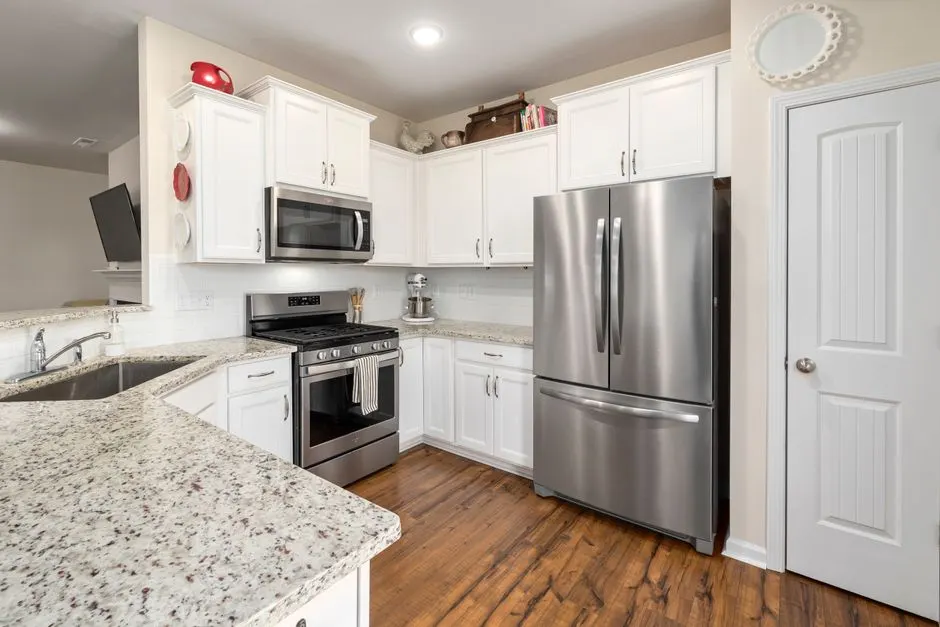
Preparing your refrigerator and freezer for Kenosha summer means three things: clean the condenser coils, verify the door seals are tight, and set the fridge to 37°F and the freezer to 0°F before the first hot week hits. Do that in May and you avoid most of the mid-July service calls local providers run every year. This guide walks through the full checklist, the mistakes that cost Kenosha homeowners the most money, and the signs that mean you should stop troubleshooting and call a technician.
Why Kenosha summers are hard on refrigerators and freezers
Kenosha summers are hard on refrigerators and freezers because the same compressor that runs fine at 68°F indoors has to work 20-30% harder when your kitchen climbs past 80°F. Every degree above 70°F in the room adds load to the condenser, and the condenser is the part that dumps heat out of the box. When it can't dump heat fast enough, the compressor runs longer, the fridge never quite reaches setpoint, and parts wear out faster.
Kenosha homes make this worse in two specific ways. First, a lot of the housing stock near the lake was built before 1970, and those kitchens were not designed for a 26-cubic-foot French-door refrigerator. The fridge ends up in a tight alcove with two inches of clearance on the sides and zero on top. Second, humidity off Lake Michigan sits high through July and August. High humidity means more condensation on door gaskets, more frost in older freezers, and more strain on any fridge with a failing seal.
Local providers see the pattern every June: a wave of calls from homes where the fridge was fine all winter and suddenly can't keep the milk cold. Almost always, the coils are packed with dust and pet hair, the gasket is torn, or the fridge is jammed into a cabinet that traps heat. All three are fixable before they become a compressor replacement.
How do I prepare my refrigerator for summer in Kenosha, Wisconsin?
You prepare a refrigerator for summer in Kenosha, Wisconsin by cleaning the condenser coils, testing the door gaskets, setting the correct temperatures, and clearing airflow around the unit - in that order. The whole job takes about 45 minutes and costs nothing if you already own a vacuum and a dollar bill.
1. Clean the condenser coils
Pull the fridge away from the wall, unplug it, and find the coils. On most models they're either on the back or behind a kick plate at the bottom front. Vacuum them with a brush attachment, then use a coil brush to get the dust the vacuum misses. In a Kenosha home with a dog or cat, expect a visible mat of hair. Clean coils can cut compressor run time by 10-15%, which shows up on your July electric bill.
2. Test the door gaskets with a dollar bill
Open the door, place a dollar bill across the gasket, and close it. If you can pull the bill out with no resistance, the seal is failing. Walk the bill around all four sides of both doors. A gasket that leaks lets cold air out and humid Kenosha air in, which is how you get frost buildup and a fridge that runs nonstop. Replacement gaskets for common brands run $40-$120 in parts.
3. Set the right temperatures
Set the refrigerator compartment to 37°F and the freezer to 0°F. Those are the FDA-recommended numbers, and they leave a safety margin for the extra door openings that come with summer entertaining. If your fridge has a digital display, verify the actual temperature with a $10 fridge thermometer on the middle shelf - the display reads the setpoint, not the real air temp.
4. Clear the airflow
Leave at least 2 inches of clearance on the sides and back, and 1 inch on top. If your fridge is built into a cabinet, make sure the toe-kick vent isn't blocked by a rug or a recycling bin. A fridge that can't breathe in a Kenosha kitchen will run 30% longer than it should all summer.
5. Vacuum the drip pan and check the drain
The drip pan under the fridge collects dust and moisture. Pull it, wash it, and put it back. While you're down there, check that the defrost drain tube isn't clogged with food debris - a clogged drain is the number one cause of water on the floor under a fridge in July.
Freezer prep that prevents summer breakdowns
Freezer prep for a Kenosha summer is mostly about airflow and frost. A full freezer runs more efficiently than an empty one, but an overpacked freezer blocks the cold air from circulating and creates warm pockets that thaw and refreeze your food.
- Leave 1 inch of space between the food and the back wall so air can move.
- Defrost manual-defrost freezers when frost hits 1/4 inch. Thicker frost acts as insulation and forces the compressor to run longer.
- Fill empty space with water bottles - they hold cold and reduce run time during power flickers, which Kenosha gets during summer storms.
- Check the freezer door gasket the same way you checked the fridge gasket. Freezer gaskets fail faster because the temperature swing across the seal is bigger.
If your freezer is a chest model in the garage, move it out of direct sun. A garage that hits 95°F in August will push a chest freezer past its rated ambient temperature, and that's when the compressor fails. If you notice the freezer running constantly or the food softening at the edges, that's a sign to get freezer repair in Kenosha, Wisconsin before you lose a few hundred dollars of meat.
Common mistakes to avoid when prepping your fridge for summer
The most common mistake Kenosha homeowners make is turning the fridge temperature down to compensate for summer heat. Colder setpoints don't fix a dirty coil or a bad gasket - they just make the compressor run longer and burn out faster. Set it to 37°F and fix the actual problem.
Other common mistakes:
- Blocking the vents inside the fridge. A shelf packed tight against the back wall stops cold air from reaching the front. Leave a gap.
- Putting a hot pot directly in the fridge. It raises the internal temp by 5-10°F for hours and forces the compressor to catch up. Let food cool to room temperature first.
- Ignoring a small water leak. A few drops under the fridge in June become a rotted subfloor by August. Find the source early.
- Skipping the coil cleaning because the fridge "seems fine." Coils don't fail loudly. They just quietly cost you money until the compressor gives out.
- Using a power strip for the fridge. Refrigerators need a dedicated outlet. A power strip adds resistance and is a fire risk during the heavy draw of a summer compressor cycle.
One more: don't stack the freezer so full that the door won't seal.
When to call a professional for refrigerator repair in Kenosha
Call a professional when the fridge is running constantly but not reaching temperature, when you see frost on the back wall of a frost-free model, or when the compressor clicks on and off every few minutes. Those are symptoms of a sealed-system or control-board problem that you can't fix with a vacuum and a sponge.
Local providers check the compressor windings, the start relay, the thermistors, and the defrost system, then tell you what's actually wrong before they touch anything. If it's a $30 relay, local providers replace the relay. If it's a sealed system leak, local providers tell you that too, and they tell you when a repair no longer makes financial sense.
That's fine - those are the two steps where a $15 part turns into a $200 repair if the door hinge gets bent or the drain line gets pushed into the insulation. If you're not comfortable pulling the fridge apart, stop and call. For the broader list of what local providers handle, see the appliance repair service Kenosha Wisconsin.
How much does refrigerator maintenance cost in Kenosha?
Refrigerator maintenance in Kenosha runs $89-$175 in 2026 for a professional tune-up that includes coil cleaning, gasket inspection, temperature calibration, and a drain check. A standard diagnostic visit without maintenance is $75-$125, and that fee usually applies toward the repair if you move forward quickly.
Compare that to the cost of the failures maintenance prevents. A compressor replacement runs $400-$800 installed. A sealed-system repair runs $350-$650. A new French-door refrigerator is $1,200-$2,800 before delivery and haul-away. The math on a $120 tune-up is not complicated.
Parts pricing matters too. A door gasket is $40-$120. A defrost heater is $60-$150. A start relay is $25-$70.
July and August book out 3-5 days in advance, and the emergency appliance repair in Kenosha, Wisconsin calls that come in during a heat wave are always more expensive than the maintenance visit that would have prevented them.
Frequently Asked Questions
How do I prepare my refrigerator for summer in Kenosha, Wisconsin?
Clean the condenser coils, test both door gaskets with a dollar bill, set the fridge to 37°F and the freezer to 0°F, and clear 2 inches of airflow around the unit. Do it in May before the first 80°F week. The whole job takes about 45 minutes.
How much does refrigerator maintenance cost in Kenosha?
Expect $89-$175 in 2026 for a professional tune-up covering coils, gaskets, temperature calibration, and the defrost drain. A diagnostic-only visit is $75-$125 and often applies toward the repair; ask the provider.
Who services refrigerators in Kenosha, Wisconsin?
Elite Appliance Repair is a free referral service. Call (833) 339-2709 and we will connect you with an independent local provider for refrigerator repair in Kenosha. Ask the provider about timing, pricing, and warranty terms before work starts.
Can I prep my fridge myself in Kenosha?
Yes, for coil cleaning, gasket testing, temperature setting, and airflow. Stop and call a pro if you find a torn gasket, a sealed-system leak, or a compressor that clicks on and off. Those need gauges and refrigerant, not a vacuum.
Is refrigerator maintenance worth it in Kenosha, Wisconsin?
Yes. A $120 tune-up prevents $400-$800 compressor replacements and $1,200+ new-fridge purchases.
Get help with Appliance Repair in Kenosha
If your fridge is already struggling, or you'd rather have a pro handle the coil cleaning and gasket check before summer hits, local providers can get you on the schedule this week. (833) 339-2709